

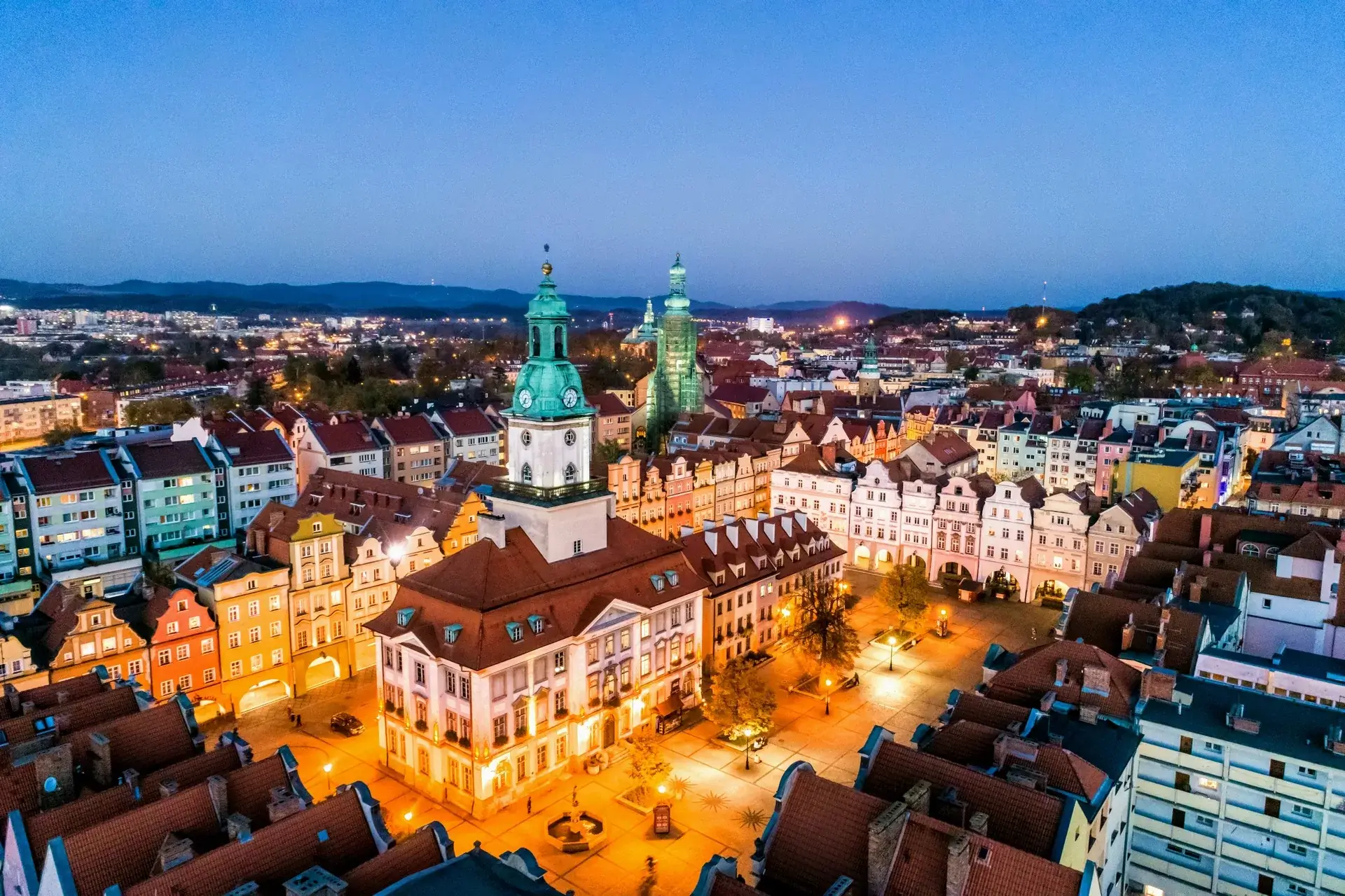
Jelenia Góra is far more than a typical seasonal tourist destination. The city benefits from three complementary demand drivers that support its hospitality market throughout the year: a strong business and administrative sector, a thriving tourism industry, and the renowned spa district of Cieplice.
This unique combination creates stable, year-round demand for hotel accommodation rather than relying solely on peak holiday seasons. Looking ahead, ongoing improvements to the region’s road and rail infrastructure are expected to further strengthen the city’s attractiveness and accessibility.
Tourism Continues to Grow
Tourism in Jelenia Góra has been steadily increasing. According to Poland’s Central Statistical Office (GUS), the city recorded more than 700,000 overnight stays in 2025 – an increase of 13% compared to 2024 and over 60% higher than before the pandemic.
Yet these figures tell only part of the story.
The Urban Gateway to the Karkonosze Mountains
Jelenia Góra consistently ranks among Poland’s strongest hotel markets in terms of occupancy. Between 2020 and 2024, the average occupancy rate exceeded 46%, placing the city first in the Lower Silesian Voivodeship and among the top-performing counties nationwide.
Interestingly, hotels located in the neighbouring Karkonosze County recorded occupancy levels that were, on average, nearly 30% lower over the same period. This demonstrates that Jelenia Góra offers a significantly more balanced and resilient hospitality market than destinations dependent primarily on seasonal tourism.
An Urban Hotel Benefits from Year-Round Demand
The city’s consistently high occupancy rates result from steady demand throughout all twelve months of the year – not only during summer holidays or the winter ski season.
Unlike purely leisure-oriented destinations, Jelenia Góra attracts a diverse mix of visitors, including business travellers, conference participants, tourists, spa guests, and people visiting the city for administrative, educational, cultural, or healthcare purposes.
As the region’s economic and administrative centre, Jelenia Góra is home to numerous public institutions, universities, hospitals, courts, cultural venues, sports facilities, and a growing business community. According to the REGON business register, more than 14,000 companies operate within the city, including dozens of medium-sized and large employers.
Its strategic location near the Czech and German borders also supports cross-border business activity, creating additional demand for accommodation throughout the year.
The Cieplice Spa District Strengthens Hotel Demand
Another important pillar of Jelenia Góra’s hospitality market is Cieplice, one of Poland’s oldest spa resorts.
The district attracts patients, accompanying family members, and visitors throughout the entire year, further reducing seasonality and reinforcing the city’s stable demand for hotel accommodation.
Strong Demand, Limited Supply
Despite the city’s growing popularity, the local hotel market remains significantly underserved.
Many existing properties are dated and offer only mid-range accommodation, while the overall hotel capacity has failed to keep pace with increasing demand. In recent years, the local hotel offering has contracted rather than expanded.
This creates a clear market opportunity for a modern, high-quality hotel capable of meeting the expectations of today’s business and leisure travellers.
Premium Hotels Create New Demand
A high-standard hotel does more than compete for existing guests – it expands the market itself.
Experience across Poland consistently shows that premium hotels achieve significantly higher occupancy rates because they attract customer segments that previously had limited accommodation options. These include international visitors, conference delegates, corporate clients, premium leisure travellers, and guests seeking a comprehensive hospitality experience.
Rather than simply redistributing demand, high-quality hotels often generate entirely new business for a destination.
Supported by the City’s Development Strategy
The need for modern hotel infrastructure has also been recognised by the local authorities.
Jelenia Góra’s official development strategy identifies the shortage of modern hotel and conference facilities (particularly within the city centre) as one of the key barriers to further tourism growth.
The strategy also highlights the city’s exceptional location at the gateway to the Karkonosze Mountains and emphasises the importance of expanding tourism, conference, cultural, wellness, and recreational infrastructure.
Importantly, these objectives are already being supported through concrete policy measures. In 2026, the City Council introduced property tax exemptions that apply, among others, to newly developed hotels.
Excellent Long-Term Growth Prospects
Jelenia Góra continues to strengthen its position not only as one of Poland’s leading tourist destinations but also as an important regional business and academic centre.
Future plans include further investment in conference infrastructure, cultural venues, event facilities, tourism, spa services, recreation, and even the city’s airport.
At the same time, accessibility is improving rapidly. The ongoing expansion of the S3 expressway, the restoration of rail connections to Karpacz, and railway modernisation towards Wrocław are making the region increasingly accessible.
Further infrastructure projects – including the planned connection between Poland’s S3 and the Czech D11 motorway, as well as the future S5 expressway, which is expected to reduce travel time from Wrocław by approximately 30 minutes – will enhance connectivity even further.
Together, these developments are expected to drive continued growth in tourism, business travel, and hotel demand across Jelenia Góra and the wider Karkonosze region.
5S Invest Research & Analysis Team
5s.com.pl
